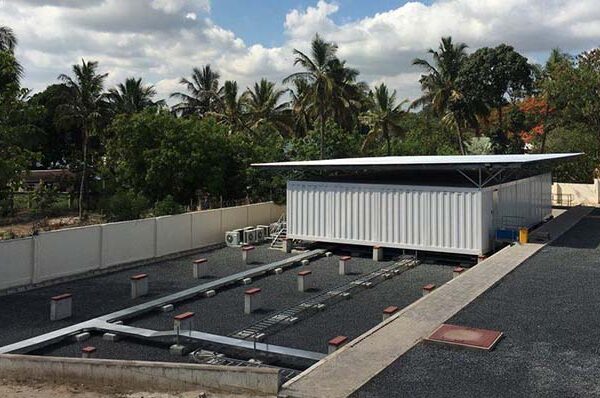

If you are planning a data centre deployment in Africa, one of the earliest and most consequential decisions you will face is whether to go modular or brick-and-mortar. Both approaches have been successfully deployed across East, West, and Southern Africa — and neither is universally better.
The right choice depends on your timeline, budget, scalability needs, and site conditions. This comparison is written for decision-makers evaluating both options in the context of African deployment realities — where power, logistics, and climate differ significantly from other regions.
Modular: Fast, Flexible, Factory-Built
Modular data centres are prefabricated in a controlled factory environment — typically inside shipping containers or custom steel modules — then shipped to site and commissioned on a prepared concrete pad. Power, cooling, fire suppression, and monitoring come pre-integrated.
Deployment takes 12 to 20 weeks compared to 12 to 24 months for traditional construction. They are ideal for requirements under 1 MW, remote or logistics-challenged sites, and organisations that want to scale incrementally as demand grows.
Many African operators now deploy modular units for immediate capacity while a permanent facility is built alongside — giving them revenue-generating infrastructure from day one.
Globotech Engineering Team
Brick-and-Mortar: Permanent, Customisable, Built to Scale
Traditional data centres are purpose-built permanent structures designed from the ground up for your specific load, cooling, and redundancy requirements. They are the right choice for facilities above 2 MW, colocation serving multiple tenants, Tier III or IV certification, and 20-plus year operational horizons.
The higher upfront cost is offset by lower cost-per-kW at scale and maximum flexibility in power and cooling system design.
How They Compare — The Factors That Matter in Africa
- Modular deploys in 12 to 20 weeks vs 12 to 24 months for traditional
- Modular has lower upfront cost but higher cost-per-kW at scale
- Traditional offers more cooling design flexibility for tropical climates
- Factory-sealed modular units handle coastal humidity and salt air better
- Modular typically achieves Tier II to III certification
- Traditional can achieve Tier III to IV with full MEP customisation
- Modular is the only practical option for remote or infrastructure-poor sites
- Traditional buildings are better suited for multi-tenant colocation models
Which Should You Choose?
Choose modular if you need capacity in under six months, the site is remote, or you want to grow incrementally. Choose brick-and-mortar if you are building for a 20-year horizon, need maximum customisation, or require Tier III or IV certification. Consider the hybrid approach — modular for day-one capacity while the permanent facility is under construction.
What matters most, regardless of approach, is that the facility is designed and built by a team with real experience deploying in African conditions. Power grid instability, tropical cooling demands, and supply chain constraints must be factored into the design from the start.